Kitchen hood fire suppression inspection on Long Island
How often your restaurant's hood system has to be inspected, who is allowed to do it in Nassau and Suffolk, and what happens if the cooking line changes or the system goes off.
Updated November 2026 by Central Fire, a veteran and firefighter owned fire protection company.
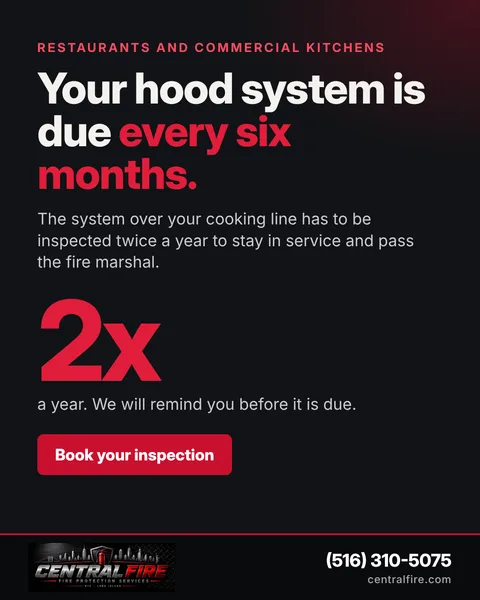
Inspect the hood system every six months with a company licensed for kitchen systems where you are. Replace the fusible links every year. If you change the cooking line, the system has to be redesigned. After a discharge, do not cook until it is recharged and reset.
- 1
Every six months, without exception
A wet chemical hood system has to be inspected and serviced at least every six months by a trained, certified technician. That is the national standard (NFPA 17A) and it is what the Nassau County Fire Marshal and Suffolk fire marshals enforce.
The technician leaves a dated service tag on the system and a written report. Keep the reports. An inspector or your insurance company will ask for them.
NFPA 17A: Wet Chemical Extinguishing Systems - 2
Use a company licensed for kitchen systems where you are
In Nassau County the company must hold a Nassau County Fire Marshal license for kitchen fire extinguishing systems, and the technician must hold a Nassau Certificate of Fitness. The county publishes the list of licensed companies.
In Suffolk County many towns and villages run their own fire marshal or code office, and some use their own inspection form. A good contractor knows which office covers your address and files what it asks for.
A license for fire extinguishers is not a license for kitchen systems. Ask to see both.
Nassau County: licensed kitchen system contractors - 3
What the six-month visit covers
Fusible links (the heat detectors over the cooking line) checked, and replaced at least once a year. Nozzles checked for grease and blow-off caps, and aimed at the right appliance.
The agent tank and cartridge checked, the manual pull station tested, and the system tripped so the gas or electric shutoff to the cooking line is proven to work.
Every appliance under the hood compared to what the system was designed for. If the cooking line changed, the system may no longer cover it.
NFPA 17A: Wet Chemical Extinguishing Systems - 4
Changed the cooking line? The system has to change too
A new fryer, a moved range or a charbroiler where a griddle used to be can leave an appliance unprotected. The nozzles and piping are designed for one exact layout.
On Long Island, changing the system usually means new plans submitted to the fire marshal before the work and an acceptance test after it. Plan for this before the new equipment arrives.
Nassau County Fire Marshal - 5
After a discharge, do not cook until it is recharged
Once the system goes off, it is empty. It has to be cleaned out, recharged with new agent, fitted with new links and reset before the line can be used again.
Call your service company the same day. Most can recharge and reset quickly if the parts for your system are on the truck.
NFPA 17A: Wet Chemical Extinguishing Systems - 6
Hood cleaning and the Class K extinguisher are separate rules
The hood and duct are cleaned on their own schedule under NFPA 96: monthly for solid fuel cooking, quarterly for high-volume kitchens like 24-hour, charbroil or wok cooking, twice a year for most restaurants, and once a year for low-volume kitchens.
A kitchen with a hood system also needs a Class K extinguisher near the cooking line (NFPA 10). It is serviced every year with your other extinguishers.
NFPA 96: Ventilation Control and Fire Protection of Commercial Cooking
- Licensed by the Nassau County Fire Marshal for kitchen fire extinguishing systems and portable extinguishers.
- Suffolk County licensed, with technicians holding Nassau and Suffolk Certificates of Fitness.
- We draw and submit the plan sets for new and changed systems ourselves.
Hood system due?
Tell us where the restaurant is and what brand the system is. We will book the inspection.
Questions
Hood suppression inspections on Long Island
At least every six months, by a certified technician from a company licensed for kitchen systems. The fusible links are replaced at least once a year, and the agent tank is pressure tested every 12 years.
Only if it is also licensed for kitchen fire suppression systems. In Nassau County that is a separate Fire Marshal license from the portable extinguisher license. Central Fire holds both.
A fire marshal can write a violation, and your insurance company may refuse a claim if the system was not serviced on time. If the tag is past six months, book the inspection now.
Older dry chemical systems do not meet today's standard for cooking oils (UL 300) and are no longer supported by the makers. If parts are no longer made for your system, it has to be replaced with a wet chemical system.
We work on the common pre-engineered wet chemical systems, including Amerex, Ansul, Badger, Buckeye, CaptiveAire, Kidde, Lehavot, ProTex and Pyro-Chem.